
Why In-Person Group Workshops Are Still One of the Most Effective Ways to Improve Communication
As workplace communication becomes increasingly digital, many professionals assume that learning communication skills should happen the same way (online, asynchronous, or self-guided). However, decades of research in learning science, communication psychology, and organizational behavior suggest the opposite: in-person group workshops remain one of the most effective environments for improving professional communication skills.
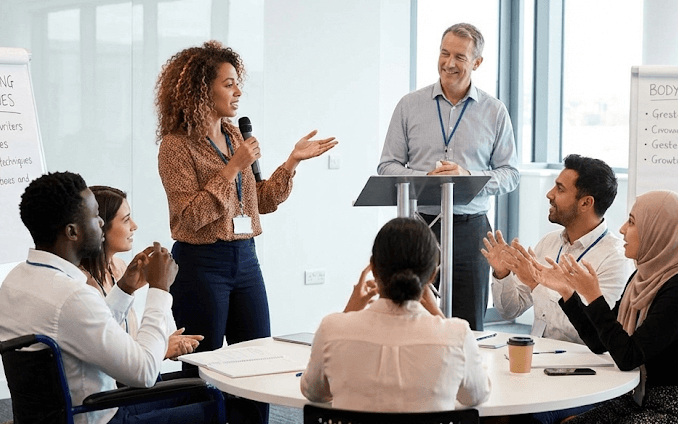
This is not about nostalgia. It is about how humans learn complex social behaviors like speaking and listening in real time.
Why Communication Skills Are Different From Other Professional Skills
Communication is a complex dynamic between linguistic and cognitive skills. It is behavioral, social, and physiological. Unlike more technical skills (e.g., scheduling, organizing), communication depends on how the nervous system responds in the presence of others.
Research in social neuroscience shows that communication behaviors such as tone, pacing, and clarity are influenced by real-time social feedback (Stephens et al., 2010). This means that learning environments which include live interaction provide richer data for the brain to adapt and improve.
In-person group workshops naturally create these conditions.
The Unique Benefits of In-Person Group Communication Workshops
1. Real-Time Feedback Improves Learning Speed
Learning theory consistently shows that immediate feedback leads to faster and more durable skill acquisition (Hattie & Timperley, 2007). In group workshops, participants receive:
Instant reactions from listeners
Natural conversational feedback
Guided observation from a professional communication coach
This real-time loop helps participants adjust their speaking behaviors more efficiently than delayed or imagined feedback.
2. Group Settings Reduce Communication Anxiety Over Time
While some professionals worry that group settings increase anxiety, research suggests the opposite when workshops are well facilitated.
Repeated exposure to low-stakes speaking opportunities in a supportive group helps reduce public speaking anxiety by desensitizing the nervous system (Bodie, 2010). Over time, participants develop greater confidence in public speaking as speaking becomes more familiar and predictable.
3. Participants Learn by Observing Others
Observational learning is a powerful mechanism for communication development. Seeing others practice, struggle, and improve provides insight that self-practice cannot.
Studies in motor and speech learning show that observing peer performance improves internal modeling of skills like pacing, articulation, and voice projection (Guillot et al., 2012).
In group workshops, participants often recognize communication patterns in others that mirror their own—without the emotional weight of self-criticism.
4. Communication Becomes Contextual, Not Abstract
One limitation of self-guided learning is that advice often feels generic. In-person workshops allow communication to be practiced in context:
Meetings
Presentations
Client conversations
Difficult discussions
This context-based practice improves transfer of skills back to the workplace, a key factor in adult learning effectiveness (Knowles et al., 2015).
5. Voice and Presence Improve Through Embodied Practice
Skills such as voice projection, speech clarity, and physical presence rely on posture, breath, and resonance. These are difficult to adjust without physical awareness and guidance.
In-person settings allow a voice projection coach or professional speech coach to address:
Vocal efficiency
Clear speaking voice
Physical alignment
Research in speech science shows that embodied feedback leads to more consistent improvement in vocal clarity than verbal instruction alone (Carnegie Mellon University, 2020).
6. Group Workshops Build Shared Communication Norms
For teams, communication improvement is not only individual—it is collective.
Organizational research shows that teams with shared communication expectations experience:
Fewer misunderstandings
Better feedback culture
Higher psychological safety
Improved collaboration (Edmondson, 2019)
In-person group workshops help teams align on how they communicate, not just what they communicate.
7. Feedback Feels Safer in Structured Group Environments
When feedback is structured and facilitated by a trained professional communication coach, it feels supportive rather than evaluative.
Clear guidelines, modeling, and normalization reduce defensiveness and increase openness to growth. This is especially important for professionals who are hesitant to seek presentation feedback in evaluative settings.
Where Data Still Plays a Supporting Role
While in-person workshops are powerful for experiential learning, research also shows that objective feedback strengthens long-term improvement.
Many professionals benefit from pairing group workshops with a communication skills assessment or speech sample analysis to:
Identify individual patterns
Track progress over time
Reinforce workshop learning
Used this way, data supports learning without overshadowing the human, interactive elements that make workshops effective.
Why In-Person Learning Still Matters in a Digital Workplace
Digital tools are efficient for information transfer. They are less effective for behavior change.
Communication skills improve most when people can:
Practice live
Receive immediate feedback
Observe others
Regulate their nervous system in real time
Apply skills in realistic scenarios
In-person group workshops create these conditions naturally.
Conclusion
In-person group workshops remain one of the most effective ways to improve professional communication because they align with how humans actually learn. They provide real-time feedback, social context, embodied practice, and psychological safety—all critical components for improving professional speaking skills.
While data-driven tools like communication analysis can support individual insight, it is the human interaction of group workshops that turns insight into lasting change.
For professionals who want objective insight alongside experiential learning, a communication analysis can provide structured presentation delivery feedback and highlight patterns that are difficult to hear on your own.
