

FREE RESOURCE
5-Minute Communication Nerves Reset
A minute-by-minute warm-up to settle your nerves, clear your voice, and show up confident.
CRAFTED BY EXPERTS
Download the Free Resource
You can use these tips immediately when nerves start interfering with how you come across.
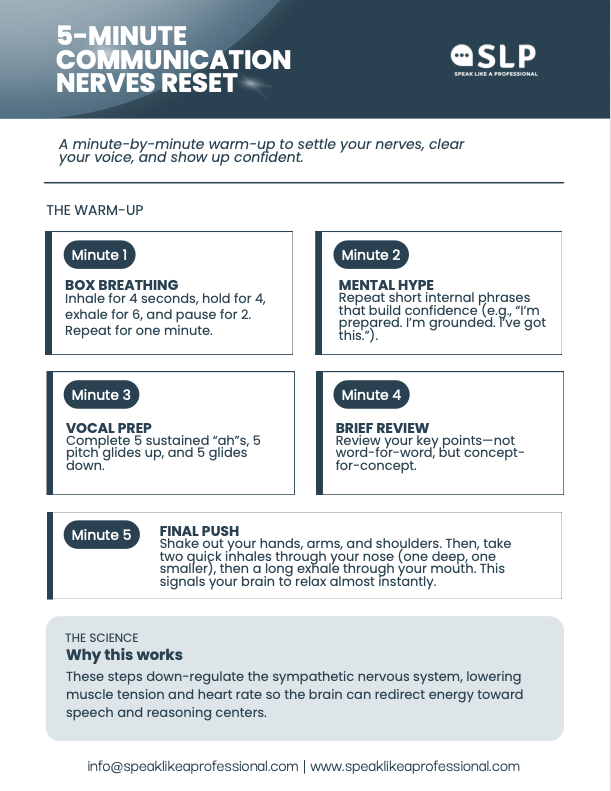
This one-page reset gives you a simple 5-minute routine to use right before a presentation, meeting, or on-camera moment. Instead of trying to “just calm down,” you’ll have a practical sequence to help:
Reduce physical tension
Steady your breathing
Warm up your voice
Get your thoughts moving again
MORE SUPPORT
Try it with our Curated Pump-Up Playlist
Genre: Hip-Hop, Rap
Find your rhythm before you take the mic. This hip-hop-driven playlist moves you from calm to confident to unstoppable, all guided by communication science.
Note: Contains Explicit Content
Sounds crazy for a service that recommends speaking like a "professional," right? But there's a reason for this: when profanity is used in the context of confidence, it can make listeners feel more energized and assertive, helping override self-consciousness and performance anxiety
Or more free resources like this? Check out our Speech Mechanics Webinar or our Communication Strengths Quiz.
A GUIDE
The Four levers of a communication Nerves Reset
8 MIN READ | BY SYDNEY PARRIOTT, MA, CCC-SLP
01
Guide your brain out of threat mode
Guided mindfulness helps interrupt the brain's habit of scanning for danger and gives your attention a steadier place to land. That matters because the sympathetic nervous system is fueled by perceived threat. When you repeatedly return your focus to a voice, a phrase, or your breath, you reduce the mental"alarm loading" that can keep your body keyed up before a meeting, interview, or presentation.
The National Center for Complementary and Integrative Health notes that meditation and mindfulness practices may help reduce stress and anxiety, and a major JAMA Internal Medicine review found mindfulness meditation programs produced meaningful improvements in anxiety symptoms
02
Replace the Threat Script
Your nervous system reacts not only to the situation itself, but to the meaning your brain assigns to it. If your inner dialogue sounds like "I'm going to blank,""They'll think I'm incompetent," or "I always mess this up," your body often responds as if danger is already happening.
REPLACE THE SPIRAL WITH
“I know my first point.”
“I can slow down.”
“I can restart my sentence if I make a mistake.”
These more accurate, performance-focused scripts help reduce the cognitive threat signal feeding sympathetic arousal. This is closely aligned with cognitive restructuring, a core part of cognitive behavioral therapy.The National Institute of Mental Health recognizes CBT as an evidence-based treatment for anxiety. Meta-analytic research also shows CBT is effective across anxiety disorders, and neuroimaging on cognitive reappraisal shows stronger prefrontal regulation with reduced emotional reactivity
SOURCES: NIMH; Hofmann et al., 2012; Buhle et al., 2014.
03
Release Tension Where Nerves Show Up First
For many professionals, stress shows up in the jaw, tongue, lips, throat, and voice before it shows up anywhere else. That tension can make your voice sound tight, rushed, effortful, or flat, which then gives your brain more evidence that the moment is not going well.
A short mouth and voice warm-up helps interrupt that loop by reducing excess tension and making speech feel easier to produce. This tool works a little differently than breathing or mindfulness: it does not directly regulate the autonomic nervous system as strongly, but it can reduce the physical strain that keeps the body feeling braced once you start talking.
Cleveland Clinic notes that excess muscle tension around the voice can interfere with how the voice functions, Mayo Clinic recommends deliberate tension-release strategies to reduce stress, and voice research supports targeted warm-ups such as semi-occluded vocal tract exercises for improving vocal efficiency and reducing strain.
FROM THE PRACTICE
Our communication analysis
An SLP-led review of your real speaking, delivered as a written report to help build confidence and reduce nerves.
SOURCES: Cleveland Clinic; Mayo Clinic; Titze, 2006.
04
Use Your Breath to Downshift Fast
Slow breathing is one of the most direct ways to influence your physiological state because breathing changes heart rate, vagal signaling, and overall autonomic balance in real time. When you lengthen the exhale and slow the pace of breathing, you send the body a stronger signal that it is safe enough to come out of immediate threat mode.
That is why breathing techniques are often the fastest part of a communication nerves reset.
Medical institutions such as Cleveland Clinic and Johns Hopkins Medicine recommend slow, diaphragmatic breathing to reduce stress, and research reviews show that paced slow breathing can improve heart rate variability and support parasympathetic activity, which helps counter sympathetic overactivation.
LOOKING FOR MORE?
Frequently Asked Questions
-
Communication coaching can help reduce communication anxiety by turning vague feelings of nervousness into trainable variables: speech rate, breath control, vocal tension, message structure, and rehearsal under pressure. That matters because performance-based anxiety is common. The National Institute of Mental Health reports that 7.1% of U.S. adults experience social anxiety disorder in a given year and 12.1% will experience it at some point in life. The most effective support is not generic reassurance. It is structured practice, feedback, and repeated exposure to the exact speaking situations that trigger you, which is consistent with the evidence base NIMH describes for anxiety-focused care. Communication coaching is not mental health therapy, but it can be a powerful non-clinical way to help you speak more steadily, think more clearly, and stay more in control when the stakes are high.
-
The strongest neuroscience-informed communication coaching options train the nervous system, not just your mindset. Look for coaching that includes biofeedback, repeated rehearsal, paced breathing, vocal warm-ups, and real-time work on speech rate, prosody, and cognitive load. That approach fits what performance science shows: people improve fastest when they can see what they are doing, practice it repeatedly, and adjust in real time. It also respects a basic cognitive limit: working memory can hold only about 4 chunks of information at a time, so dense, rapid communication becomes harder for both the speaker and the listener to manage. In practical terms, the highest-value options are usually 1:1 coaching, communication analysis, or live skill-based workshops that let you practice the exact task you want to improve.
-
The communication coaching that improves interview performance most is coaching that strengthens answer structure and delivery at the same time. The strongest options teach you how to organize answers with repeatable frameworks, reduce unnecessary length, control pace and filler, and rehearse out loud under realistic pressure. That approach is consistent with selection science: in a landmark meta-analysis, structured interviews were more predictive of job performance than unstructured interviews with validity estimates of about .51 versus .38. The U.S. Office of Personnel Management also recommends structured interviews because they increase consistency and job-relatedness. When your answers are easier to follow, you do not just feel more confident. You give decision-makers clearer evidence of your fit.
-
The best executive presence coaching services do more than polish appearance or posture. They strengthen the communication behaviors that make leaders feel credible in one room and relatable in another: message clarity, listening, audience adaptation, vocal authority, and composure under pressure. In a widely cited Center for Talent Innovation study of 268 senior executives, communication accounted for 28% of executive presence, second only to gravitas at 67%, and far ahead of appearance at 5%. That is why the highest-value executive presence coaching usually includes a communication analysis, 1:1 coaching, role-play across leadership scenarios, and targeted work on vocal delivery and stakeholder communication. If a service is only helping you “look executive” but not helping you sound clearer, listen better, and respond with more range, it is leaving performance on the table.
LET’S TALK
Ready when You are.
Tell us a little about what you’re working toward. We’ll be in touch within one business day.