
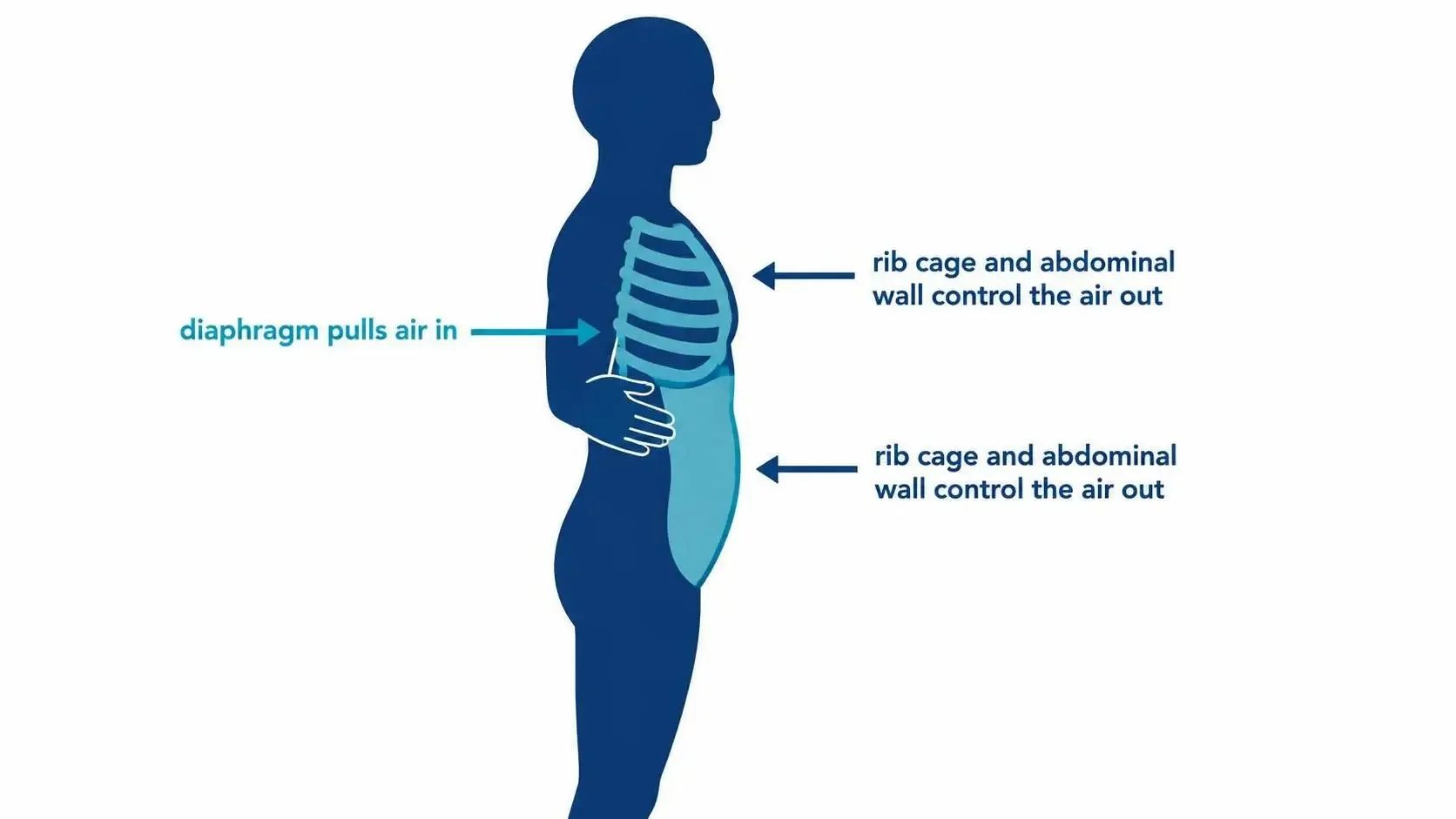
"Speak from your diaphragm" is a coaching cue for breath-powered speech, not a literal instruction. The diaphragm pulls air in. While you talk, the rib cage and abdominal wall ease inward to keep air pressure steady. To do it, take a low, quiet breath, keep the throat loose and let the belly wall move slowly in as you speak.
What does it mean to speak from your diaphragm?
"Speak from your diaphragm" means power the voice with steady breath instead of throat squeeze. The phrase is a coaching cue, not anatomy. The diaphragm fills the lungs, and the muscles of the rib cage and abdomen then control the air that carries each sentence.
Diaphragmatic breathing is a form of breathing done by contracting the diaphragm, the sheet of muscle that separates the chest from the abdomen. The cue contrasts two ways of making sound:
Throat-driven speech squeezes the larynx, the voice box, to make the sound bigger.
Breath-supported speech lets steady air pressure do that work, so the throat stays loose.
Every speaker already breathes with the diaphragm. The honest answer to "Do you use your diaphragm to talk?" is yes, on every breath in. The cue is about using that breath well, not switching on a new muscle. One thread on Reddit's r/VoiceActing asks whether speaking from the diaphragm is "an actual physical thing or is it all mental."
Breath support is part of delivery, Pillar 5 of The Resonant Communication Method™. Supported speech breathing is also separate from slow breathing to calm nerves, which has its own guide on relaxation techniques for public speaking nerves.
What does the diaphragm actually do when you talk?
The diaphragm is the main muscle of inhalation, and it mostly relaxes while you talk. A speech-science study of upright conversation found the rib cage and abdomen control the outgoing air. The diaphragm takes the quick breath between phrases and sets up the next sentence.
StatPearls, a clinical reference, describes the diaphragm on a breath in: it "contracts, flattening and expanding the thoracic cavity." When the diaphragm relaxes, air leaves the lungs passively.
Hixon, Mead and Goldman (1976, Journal of Speech and Hearing Research) measured the chest wall during speech. In upright conversation, chest-wall effort was continuously expiratory, with "control being vested in the rib cage and the abdomen." The abdomen also "mechanically tunes the diaphragm," so speakers take quick breaths with minimal interruption.
Many voice guides say the diaphragm pushes the air out. The diaphragm does not; the rib cage and abdominal muscles control the exhale. The opposite claim, that the diaphragm does nothing during speech, goes too far. The diaphragm powers every quick breath between phrases. Hixon and colleagues also found that an utterance starting from a very full breath begins with a braking phase, in which breathing-in muscles hold back the lungs' recoil.
Three muscle groups share the work:
Diaphragm: pulls air in on each quick breath.
Rib cage muscles: keep air pressure steady through the phrase.
Abdominal wall: eases inward to finish the phrase, then releases for the next breath.
How do you know if you are speaking from your throat?
Throat-driven speech often shows up as a tight jaw or neck, shoulders that lift on each breath, a voice that fades at sentence ends and a tired throat after meetings. Breath-supported speech feels different: the belly wall eases slowly inward while the throat stays loose.
Four habits to notice (habits, not a diagnosis):
Jaw and neck tension on the first words of a sentence.
Shoulder lift on the breath in, the mark of a high, effortful breath.
Fading or creaking on the final words of a sentence.
Throat fatigue at the end of a talk-heavy day.
The 30-second hand check works standing up:
1. Place one hand on the upper chest and one hand just below the ribs.
2. Say a long sentence at meeting volume, such as a status update.
3. Watch the hands. The lower hand moves slowly inward, and the upper hand stays quiet.
The lower hand moves because the abdominal wall is active during upright speech, a pattern recorded by Hixon and colleagues (1976) and by Hoit and colleagues (1988). Many people mistake that inward pull for the diaphragm. The inward pull is the abdominal wall at work.
How do you speak from your diaphragm, step by step?
Speak from your diaphragm in six steps: feel the low breath lying down, check it standing, sustain an "s", count on one easy breath, hum into words, then speak in thought groups. The order moves from breath alone to sound, words and real workplace sentences.
1. Feel the low breath lying on your back, one hand on the belly. The belly rises on each breath in. Trains: awareness of a low breath. The floor is only the starting point (see the posture section below).
2. Stand and repeat the hand check from the section above. Breathe in quietly, with no gasp and no shoulder lift. Trains: the same low breath in the posture of real speech.
3. Sustain a soft "sss" on one breath out. Feel the belly wall move inward at an even speed. Stop before the throat tightens. Trains: a steady, controlled exhale.
4. Count aloud on one easy breath at speaking volume, and stop with air to spare. Hoit and colleagues (1988) found that abdominal muscle activity rose at low lung volumes; in practice, throat squeeze creeps in near the bottom of the breath. Trains: speaking from the middle of the breath.
5. Hum into words: "mmm-one," "mmm-many," "mmm-Monday." Humming is a semi-occluded vocal tract exercise: the closed lips partly block the airway. Titze (2006) explains, from computer simulations, how semi-occlusion can make voicing more efficient. Trains: resonance and an easy start to each word.
6. Speak in thought groups: one idea per breath, with a quiet breath at each comma or period. Winkworth and colleagues (1995) found that speakers took most breaths at clause boundaries and breathed in more before longer stretches. A sentence that outlasts its breath tends to fade on the last words, a pattern that often goes with creaky voice at the ends of sentences. Trains: breath support for speaking in full sentences.
Practice for about five minutes, two or three times a day, standing. Move each step into real material: a status update, an email read aloud, the opening line of the next presentation.
Does posture change how you breathe when you speak?
Posture changes which muscles drive speech breathing. In a 1988 study of 10 adults, the side abdominal muscles were highly active during upright speech and only occasionally active lying down. Belly breathing on the floor builds awareness; the skill needs practice standing and sitting.
Hoit, Plassman, Lansing and Hixon (1988, Journal of Applied Physiology) recorded abdominal muscle activity in five men and five women. The activity was "most prevalent during loud speech production and during speech produced at low lung volumes."
Hixon and colleagues (1976) found the same split. Lying on the back, control of the outgoing air sat "typically in the rib cage alone." Upright, the rib cage and abdomen shared the work.
Floor practice teaches the feel of a low breath but trains a different muscle pattern. Practice in the posture of the real task: standing for a talk, sitting upright for a meeting or a call.
How do you project your voice without yelling?
Project your voice without yelling by aiming at the farthest listener, keeping the throat loose and letting steady breath, open vowels and clear consonants carry the sound. Projection is breath, resonance and articulation. Yelling adds throat effort, tends to raise pitch and tires the voice.
Breath support is the engine. Projection is how that engine reaches the back of a room. Wikidata defines voice projection as the "strength of speaking or singing whereby the voice is used loudly and clearly."
Projection has three components:
Breath: steady air pressure from the rib cage and abdominal wall.
Resonance: the forward buzz practiced in the humming step.
Articulation: consonants that finish every word, so word endings reach the listener.
Nawka and colleagues (1997, Journal of Voice), studying male voices only, found that professional speakers showed a stronger "speaker's formant," an energy peak in the upper frequencies of the voice. The authors reported that "shouting increases the spectral energy of the adjacent critical bands but not the speaker's formant itself." In these male voices, the peak marked professional speakers, and shouting did not add to it.
Lindsay Price, writing for Theatrefolk, puts the coach's view bluntly: "If your diaphragm is not doing the work of creating volume, your vocal cords are." Read "diaphragm" as the whole breath system, and the point holds.
Search suggestions such as "how to project your voice without yelling" show the same worry. Breath support is also the first of the three foundations of a leadership voice.
Does taking a bigger breath make you louder?
A bigger breath alone does not make you louder. In a study of spontaneous speech, louder talk within each speaker's normal range was not linked to larger inhalations. Loudness comes from steady air pressure and efficient vocal-fold vibration; a fuller breath mainly helps long sentences.
Winkworth, Davis, Adams and Ellis (1995) recorded six women across seven to ten sessions. The authors wrote that "increases in speech intensity within individual ranges were not associated with increased lung volumes."
Titze and Sundberg (1992, Journal of the Acoustical Society of America) found that sound level rose "8-9 dB per doubling of excess pressure over threshold." At the same pressure, trained tenors were 10 to 12 decibels louder than male nonsingers, mainly through higher airflow. Efficiency, not lung size, made the difference.
Huber and colleagues (2005, Journal of Applied Physiology) gave 30 young adults three cues to get louder: a target level, "twice as loud" and speaking in noise. All three cues raised loudness by similar amounts, each with a different breathing pattern. "Twice as loud" leaned on extra squeeze from the breathing-out muscles. Huber (2007) found the same pattern in connected speech from 30 adults and reported results that support the idea that intention plays a role in speech breathing.
These studies suggest that the instruction you give yourself shapes how you breathe. The practical inference, not a tested instruction: aim the voice at a real listener at the back of the room rather than telling yourself to be twice as loud.
Why does your voice get lost in large rooms and open-plan offices?
A voice gets lost in large rooms because sound weakens with distance and background noise competes with it. In open space, each doubling of distance cuts sound level by about 6 decibels. Open-plan noise also triggers the Lombard effect, an automatic rise in vocal effort.
HyperPhysics (Georgia State University) sets out the inverse-square law: sound intensity falls with the square of the distance "if there are no reflections or reverberation." The 6-decibel figure follows from that law in open space. Real rooms lose less, because walls and ceilings reflect sound.
Olsen (1998, American Journal of Audiology), summarizing a 1977 report by Pearson, Bennett and Fidell, put usual speech levels in schools, homes, hospitals and stores "between 55 and 66 dBA at conversation distances."
The Lombard effect is the "involuntary tendency of speakers to increase their vocal effort" in noise. The effect is named after Étienne Lombard, who described it in 1911, and it also raises pitch. In an open-plan office, notice the automatic push and route it into breath and resonance instead of the throat.
Huber and colleagues (2005) found that speaking in noise also slowed speaking rate. The pacing side is covered in the guide to slowing down with planned pauses. For structured practice, the Delivery Workbook & Tool Chest includes a volume-projection plan for rooms of different sizes.
When should you use a microphone instead of projecting?
Use a microphone whenever the room size, the audience or a long speaking day would force you to push your voice. In a trial of 64 teachers with voice disorders, voice amplification reduced voice handicap scores, while breathing-muscle training did not.
Roy and colleagues (2003, Journal of Speech, Language, and Hearing Research) randomly assigned 64 teachers with voice disorders to voice amplification (25 teachers), resonance therapy (19) or respiratory muscle training (20). The authors reported: "Only the VA and RT groups reported significant reductions in mean VHI scores." VA is voice amplification, RT is resonance therapy, and VHI is the Voice Handicap Index, a self-rated measure of how much a voice problem affects daily life.
The trial studied teachers with voice disorders, not healthy presenters, but the principle carries over: a microphone removes the need to push.
Video and phone calls follow the same logic. A headset or external microphone placed close to the mouth can let you stay at conversational level. Breath support still keeps sentences from fading at the ends. Sydney also offers one-to-one coaching on projection for virtual or in-person meetings.
Do breathing exercises alone fix a weak or tired voice?
Breathing exercises alone do not fix every weak or tired voice. A 2020 systematic review found current evidence does not support respiratory exercises for every patient with a voice disorder. It noted that many patients do not need extensive breath support for their voice demands.
Desjardins and Bonilha (2020, Journal of Voice) screened 650 articles and kept 23, covering nine types of respiratory exercise. The authors point to "generalizing the outcomes of respiratory exercises to voice tasks" as the open question. Breath drills are more useful when the gains carry into real speech, which is why the six steps above end in sentences, not silent breathing.
The teacher trial above points the same way.
Breath support still helps most when breath is the limiting part of the voice, for example when sentences run out of air or fade at the ends. The guide to developing a clear speaking voice sets breath support beside vocal care and tone.
Does speaking from your diaphragm make your voice deeper?
Speaking from your diaphragm does not make your voice deeper. Pitch is set at the larynx by the length and tension of the vocal folds, not by breathing muscles. Breath support can make a voice steadier, fuller and easier to hear at its natural pitch.
Search suggestions such as "speak from your stomach so it sounds deeper" show how often the two goals get mixed. Popular deeper-voice videos also present diaphragm work as a route to a lower voice. Research for this guide found no study linking breathing technique to a lower habitual pitch.
Pitch level is a separate topic, covered in the guide to lowering a high-pitched voice safely.
How does a speech-language pathologist train breath support for speaking?
A speech-language pathologist trains breath support by first finding which part of the voice is limiting it: breathing, vocal-fold vibration, resonance or articulation. Breath work then moves in stages from silent breathing to sounds, single words, reading aloud and live conversation at work.
The stages run in order, so that drill gains carry into real speech:
Silent breathing with the hand check.
Sustained sounds such as "sss" and humming.
Single words and short phrases on one breath.
Reading aloud in thought groups.
Live conversation in meetings and presentations.
Bhattacharyya (2014, The Laryngoscope), using 2012 US survey data, found that about one in 13 adults report a voice problem each year, and only 10% of them saw a professional for it.
The US clinical guideline on hoarseness (Stachler and colleagues, 2018) advises a throat examination when hoarseness fails to resolve or improve within four weeks, or sooner when a serious cause is suspected. Pain when speaking, or a voice that cuts out, also belongs with a doctor or speech-language pathologist. Daily habits that protect the voice are covered in a separate guide to preventing vocal strain on long workdays.
Sydney Parriott, MA, CCC-SLP, MBA, is a licensed corporate speech-language pathologist. Sydney trains breath support and projection as part of delivery. Speak Like a Professional coaches the habit and does not diagnose or treat voice disorders. Our public speaking coaching on breathing and vocal projection works on these skills in real workplace speech.
Speaking From Your Diaphragm FAQs
How long does it take to learn to speak from your diaphragm?
Research for this guide found no study that sets a timeline for healthy speakers. Many people notice an easier start in the first session, because the hand check gives instant feedback. Making it automatic takes short daily practice that moves from drills to reading aloud to real meetings, so the new habit transfers to work.
Should you speak from your diaphragm all the time?
No. Supported breathing is how speech breathing works when nothing interferes, so supported speech feels ordinary, not effortful. Quiet conversation needs little extra breath. Extra support matters for long sentences, large rooms, noise and loud speech, the moments when throat effort usually takes over.
Can you control your diaphragm?
Partly. The diaphragm works automatically, and a medical reference describes diaphragm function as primarily involuntary, with voluntary control added when needed. The diaphragm itself is hard to feel, but you can control the timing and depth of a breath and the slow inward movement of the abdominal wall.
Is speaking from your stomach the same as speaking from your diaphragm?
Yes, "speak from your stomach" is the same cue in different words. Nothing comes from the stomach itself. The belly moves outward as the diaphragm lowers on a breath, and the abdominal wall eases inward as you speak, so the stomach is where the movement is felt.
Sources
Hixon, T. J., Mead, J., and Goldman, M. D. (1976). Dynamics of the Chest Wall during Speech Production: Function of the Thorax, Rib Cage, Diaphragm, and Abdomen. Journal of Speech and Hearing Research, 19(2), 297–356. doi.org/10.1044/jshr.1902.297
Hoit, J. D., Plassman, B. L., Lansing, R. W., and Hixon, T. J. (1988). Abdominal muscle activity during speech production. Journal of Applied Physiology, 65(6), 2656–2664. doi.org/10.1152/jappl.1988.65.6.2656
Winkworth, A. L., Davis, P. J., Adams, R. D., and Ellis, E. (1995). Breathing patterns during spontaneous speech. Journal of Speech and Hearing Research, 38(1), 124–144. doi.org/10.1044/jshr.3801.124
Huber, J. E., Chandrasekaran, B., and Wolstencroft, J. J. (2005). Changes to respiratory mechanisms during speech as a result of different cues to increase loudness. Journal of Applied Physiology, 98(6), 2177–2184. doi.org/10.1152/japplphysiol.01239.2004
Huber, J. E. (2007). Effect of Cues to Increase Sound Pressure Level on Respiratory Kinematic Patterns During Connected Speech. Journal of Speech, Language, and Hearing Research, 50(3), 621–634. doi.org/10.1044/1092-4388(2007/044)
Titze, I. R., and Sundberg, J. (1992). Vocal intensity in speakers and singers. Journal of the Acoustical Society of America, 91(5), 2936–2946. doi.org/10.1121/1.402929
Titze, I. R. (2006). Voice Training and Therapy With a Semi-Occluded Vocal Tract: Rationale and Scientific Underpinnings. Journal of Speech, Language, and Hearing Research, 49(2), 448–459. doi.org/10.1044/1092-4388(2006/035)
Nawka, T., Anders, L. C., Cebulla, M., and Zurakowski, D. (1997). The speaker's formant in male voices. Journal of Voice, 11(4), 422–428. doi.org/10.1016/s0892-1997(97)80038-0
Desjardins, M., and Bonilha, H. S. (2020). The Impact of Respiratory Exercises on Voice Outcomes: A Systematic Review of the Literature. Journal of Voice, 34(4), 648.e1–648.e39. doi.org/10.1016/j.jvoice.2019.01.011
Roy, N., Weinrich, B., Gray, S. D., Tanner, K., Stemple, J. C., and Sapienza, C. M. (2003). Three Treatments for Teachers With Voice Disorders: A Randomized Clinical Trial. Journal of Speech, Language, and Hearing Research, 46(3), 670–688. doi.org/10.1044/1092-4388(2003/053)
Olsen, W. O. (1998). Average Speech Levels and Spectra in Various Speaking/Listening Conditions: A Summary of the Pearson, Bennett, & Fidell (1977) Report. American Journal of Audiology, 7(2), 21–25. doi.org/10.1044/1059-0889(1998/012)
Bhattacharyya, N. (2014). The prevalence of voice problems among adults in the United States. The Laryngoscope, 124(10), 2359–2362. doi.org/10.1002/lary.24740
Stachler, R. J., et al. (2018). Clinical Practice Guideline: Hoarseness (Dysphonia) (Update) Executive Summary. Otolaryngology–Head and Neck Surgery, 158(3), 409–426. doi.org/10.1177/0194599817751031
Kokatnur, L., Vashisht, R., and Rudrappa, M. Diaphragm Disorders. StatPearls, NCBI Bookshelf (updated 18 July 2024). pubmed.ncbi.nlm.nih.gov/29262242
HyperPhysics, Georgia State University. Inverse Square Law for Sound. hyperphysics.gsu.edu/hbase/Acoustic/invsqs.html
Price, L., Theatrefolk. Projecting Your Voice Without Yelling. theatrefolk.com/blog/projecting-your-voice-without-yelling
Lombard effect. Wikipedia. en.wikipedia.org/wiki/Lombard_effect
Diaphragmatic breathing (Q811123) and voice projection (Q641169). Wikidata. wikidata.org/wiki/Q811123 · wikidata.org/wiki/Q641169