
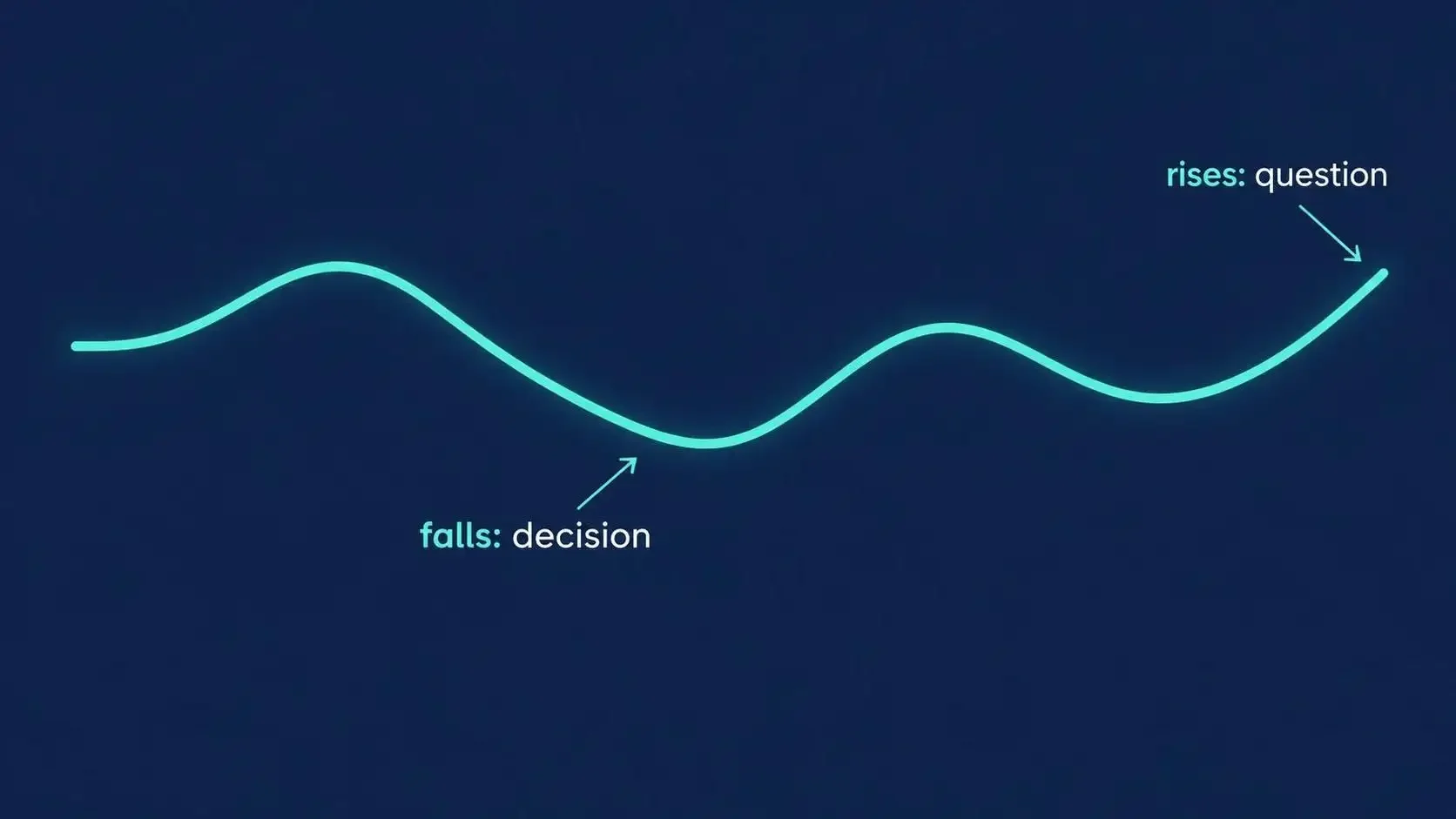
Voice inflection is the rise and fall of pitch while you speak. A falling inflection tells listeners a point is finished, a rising inflection invites a reply or signals more to come, and a level inflection sounds flat. In a 1999 study, listeners understood sentences less accurately when their pitch contour was flattened, so inflection carries meaning, not just interest.
What is voice inflection?
Voice inflection is the change in pitch inside a word or at the end of a phrase. Pitch rises, falls or stays level. Listeners use these movements to tell questions from statements, finished points from unfinished ones, and key words from the rest.
Pitch is how high or low a voice sounds. Speech scientists track pitch through fundamental frequency, written F0. Voice inflection is the movement of F0 across a word or a phrase, not the height of the voice itself.
The Wikipedia entry on intonation lists six functions of pitch movement. This guide covers four of the six:
Grammar. A rise often marks a yes-or-no question, and a fall marks a statement.
Discourse. A fall signals a finished point, and a rise or a held pitch signals more to come.
Focus. A pitch movement on one word marks that word as the new information.
Attitude. The shape of the pitch adds certainty, doubt or warmth on top of the words.
Voice inflection is one part of delivery, Pillar 5 of The Resonant Communication Method™.
What is the difference between inflection and intonation?
Intonation is the melody of a whole sentence; inflection is one turn in that melody, usually on a key word or final syllable. Both differ from pitch level, how high or low a voice sits. In grammar, inflection means word endings such as -ed.
Three terms, side by side:
Pitch: how high or low the voice sounds.
Intonation: the pattern of pitch across a whole phrase or sentence.
Inflection: a single rise, fall or bend inside that pattern, on one word or syllable.
Toronto Speech Therapy, a speech-language pathology clinic, draws the same line: "Pitch refers to the highness and lowness of tone or voice, and intonation is how pitch varies in spoken language." The same article says inflection "refers more to single words or syllables."
Wikipedia's intonation entry opens with the note "Not to be confused with inflection." Grammar uses "inflection" for changes in word form, such as walk to walked. The double meaning of "inflection" feeds the confusion.
A rising ending is movement; a voice that sits high overall is level. One commenter on Reddit's r/womenintech made the distinction plainly: "It's the uptalk, not the overall pitch of your voice." Pitch level has its own guide on a high-pitched speaking voice and what shapes it.
What are the types of voice inflection?
Speech coaches name four types of voice inflection: rising, falling, level and circumflex. Rising inflection lifts pitch and invites a response. Falling inflection drops pitch and closes a point. Level inflection holds pitch flat. Circumflex inflection bends pitch both ways for emphasis or irony.
Each type, with sample work wording and what the listener hears:
Rising inflection. "Does Thursday work for the review?" Pitch climbs on "review," and the listener hears an open question that expects an answer.
Falling inflection. "The budget is approved." Pitch drops on "approved," and the listener hears a settled point.
Level inflection. "The next item is staffing." Pitch stays flat, and the listener hears a neutral announcement.
Circumflex inflection. "Oh, that's a great deadline." Pitch rises and falls on "great," and the listener hears irony or strong emphasis.
Sentence endings mostly come down to rising and falling inflection, and listeners use those endings to decide whether a point is finished.
A falling inflection lowers pitch, not volume, so the final word still carries to every listener. Rising inflection covers two different patterns: genuine questions, and rises on statements, known as uptalk. The section on upward inflection below covers the second pattern.
Level inflection on sentence after sentence becomes monotone, the absence of inflection. Causes and a step-by-step plan sit in the separate guide to fixing a monotone voice.
What are examples of voice inflection at work?
Voice inflection at work sounds like a falling pitch on a decision, a rising pitch on a real question and a lift on the word that matters. "We launch Monday" falls to close the point. "Can legal sign off Friday?" rises to invite an answer.
All wording below is sample wording, not client stories. In each version of "I didn't approve the budget," the bold word carries the pitch lift:
- "I didn't approve the budget." Someone else approved the budget.
- "I didn't approve the budget." The approval never happened.
- "I didn't approve the budget." The speaker reviewed the budget but did not sign off.
- "I didn't approve the budget." The speaker approved something else.
- "I didn't approve the budget?" A final rise signals surprise at a claim.
Four work situations follow the same logic:
Status update. "The vendor contract is signed." A fall on "signed" marks the item as closed.
List of options. "We can delay, cut scope or add staff." Pitch rises on "delay" and "scope," then falls on "staff" to end the list.
Decision in a meeting. "We go with option two." A clear fall on "two" ends the discussion.
Question to a client. "Is the March start date still realistic?" A final rise marks a real question.
The same words also carry different attitudes. A short fall on "Fine" sounds settled; a slow fall-rise on "Fine" sounds reluctant. Emotional coloring beyond pitch, such as warmth or curtness, belongs to tone of voice at work.
Why does voice inflection matter at work?
Voice inflection matters at work because pitch movement helps listeners understand speech, not only enjoy it. In a 1999 study, listeners transcribed sentences less accurately when the pitch contour was flattened. In 2024 experiments, falling pitch at sentence ends can signal speaker confidence.
Four studies bear on how listeners use pitch and voice:
- Understanding. Laures and Weismer (1999, Journal of Speech, Language, and Hearing Research) resynthesized sentences from two male speakers with a flattened F0 contour and timing held constant. For 10 listeners, intelligibility was significantly lower by both measures. The experiment was small and preliminary.
- Naturalness. Anand and Stepp (2015) had 16 listeners rate speech from 16 speakers with Parkinson's disease and 5 controls. Monopitch was only moderately correlated with intelligibility but highly correlated with how natural the speech sounded.
- Confidence. Vaughan-Johnston, Guyer, Fabrigar, Lamprinakos and Briñol (2024, Personality and Social Psychology Bulletin) ran three experiments. Falling intonation at sentence ends, compared with rising, can signal speaker confidence. The persuasion benefit appeared only under some conditions.
- Judgments of the speaker. Schroeder and Epley (2015, Psychological Science) found that hypothetical employers and professional recruiters rated job candidates as more competent, thoughtful and intelligent when they heard a pitch rather than read it. Adding video did not change the evaluations.
The Schroeder and Epley finding concerns the whole voice, not inflection alone. The voice itself carries signals of thinking, and pitch movement is one channel inside it. Listeners treat pitch movement as information about the message and about the speaker.
What does upward inflection at the end of a sentence mean?
Upward inflection at the end of a statement, called uptalk or high rising terminal, often signals "I'm not finished" or "Are you following?" In a UC San Diego study, 16% of simple statements ended in uptalk, and rises marked 45% of floor-holding utterances.
Wikipedia's entry on high rising terminal lists other names for the rising ending on a statement: rising inflection, upspeak, uptalk and high rising intonation.
Ritchart and Arvaniti (2014, Speech Prosody conference) recorded 23 UC San Diego undergraduates. Statement rises started later than question rises, and question rises were bigger. A listener can often hear the difference between a statement rise and a real question.
A rise on a statement does three jobs:
Holding the floor, so the speaker keeps the turn in the middle of an explanation.
Checking that the listener follows one step before the next.
Inviting agreement without asking a direct question.
The speaker's intent and the listener's reading can differ. That gap is where the credibility question starts.
Uptalk is often discussed alongside vocal fry, a separate voice quality with its own guide.
Does uptalk hurt your credibility at work?
Uptalk can cost credibility at work, and the cost falls unevenly. A 2023 working paper found that uptalk by female executives on earnings calls, but not male executives, predicted lower analyst recommendations and forecasts. The practical answer is choice: fall on decisions, rise for questions.
Divakaruni, Fritsch, Jones and Morrison (2023) studied company earnings calls in an SSRN working paper. When female executives used uptalk, analysts issued lower recommendations and earnings forecasts, and bid-ask spreads widened. The authors read the pattern as consistent with uptalk being "a female-typed characteristic signalling uncertainty." The paper is a working paper, not a peer-reviewed article.
A reply in the r/womenintech thread asked, "Why should you have to change your voice?" The question is fair. The answer here is choice, not correction. A speaker who knows what each ending signals decides where a rise helps and where a fall serves better:
Fall on decisions, numbers and recommendations.
Rise on genuine questions and when inviting input.
Pause instead of rising to hold the floor. Another r/womenintech reply noted that "a pause sounds more confident and in control."
Useful rises stay. A rise that checks understanding or invites agreement still has a job in a meeting.
Does varying your pitch make you more persuasive?
Varying pitch alone does not reliably persuade. Across four experiments by Van Zant and Berger, speakers raised their pitch when trying to persuade, yet pitch cues did not change listeners' attitudes. Louder speech and varied volume did, by making speakers sound confident.
Van Zant and Berger (2020, Journal of Personality and Social Psychology) state the null result directly: "Though speakers increased their pitch, pitch variability, and speech rate during paralinguistic attempts, these cues did not impact attitudes." The authors add that the rise in pitch variability "is not robust to alternative pitch settings." Volume and volume variation signaled confidence, and confidence persuaded.
Guyer, Fabrigar and Vaughan-Johnston (2019, Personality and Social Psychology Bulletin) ran three experiments with 394, 412 and 397 participants. Speech rate, falling versus rising intonation, and pitch each shifted how confident the speaker seemed. Perceived confidence then shifted attitudes.
Vocal variety is pitch, volume, pace and pause working together. Inflection does its best work on sentence endings, where a fall signals certainty.
How do you keep inflection on video calls, phone calls and scripted talks?
Inflection survives video calls, phone calls and scripted talks when the speaker plans pitch movement in advance. Mark a falling arrow over each decision and a rising arrow over each real question. Speak from bullet points and stress one key word per sentence.
A poster on Reddit's r/NewTubers described sounding stale and feeling "like I'm reading an essay." A reply on r/podcasting gave a one-line fix for a similar complaint: "Punch up one word per sentence."
Three steps keep inflection in prepared speech:
1. Mark the script or notes with a down arrow over each decision and an up arrow over each real question.
2. Speak from bullet points instead of full sentences, so the wording forms in the moment.
3. Check a 30-second recording of the opening and count how many arrows the voice actually followed.
On an audio-only call, the listener has no face or slide to read, so pitch movement can carry more of the message.
What voice inflection exercises improve pitch variety?
Five voice inflection exercises build pitch variety: arrow-marking a recording, moving stress across one sentence, gliding pitch on a vowel, exaggerating then toning down, and rehearsing a real update. The order moves from isolated drills to live workplace speech, where content competes for attention.
1. Record and mark. Record a one-minute work update. Play the recording back and draw an arrow over every sentence ending: up, down or flat. Count the rises on statements. Trains: hearing your own pattern.
2. Move the stress. Read "I didn't approve the budget" five times, lifting a different word each time. Trains: focus, the pitch lift that marks new information.
3. Glide the pitch. Slide pitch up and down on a vowel such as "ah," then on a short phrase such as "next quarter." Trains: range, the distance between the lowest and highest comfortable notes.
4. Exaggerate, then tone down. Read a paragraph with oversized rises and falls, then read the paragraph again at half size. Trains: freedom of movement. One r/podcasting commenter wrote that speaking "really over the top" was the only thing that fixed a flat delivery.
5. Rehearse a real update. Take the arrows from exercise 1 into an update for an upcoming meeting and rehearse the update twice. Trains: carryover into live work speech.
Spoken With Authority, a speaking-coach blog, adds a "staircase" variant: start a phrase on a high pitch, step down in stages, and end on a low pitch.
The order mirrors how speech-language pathologists stage practice: isolated drills, then reading aloud, then structured talk, then conversation. The Delivery Workbook & Tool Chest adds inflection drills that make the same sentence sound curious, confident or dismissive.
Can you measure voice inflection objectively?
Voice inflection can be measured objectively with pitch-tracking software that draws the pitch contour of a recording. Praat, free software from the University of Amsterdam's phonetic sciences group, does this. Van Zant and Berger used Praat to measure pitch in their persuasion recordings.
A pitch contour is a line that rises and falls over time. Flat stretches show level inflection. Upward hooks at sentence ends show rises. Most voice inflection advice stops at "record yourself and listen." A contour adds a picture, so a speaker sees rises the ear passes over.
Measurement has limits. One recording is one sample, so patterns show up across several recordings, not one. Pitch trackers can mislabel creaky or whispered stretches as pitch changes.
A communication analysis that measures tone and pitch reviews up to 15 minutes of a real meeting, presentation or call and returns a timestamped written report.
How does a speech-language pathologist train voice inflection?
A speech-language pathologist trains voice inflection by measuring pitch range and contour, then practicing in stages from words to live conversation. Speech science treats monotone pitch as a perceptual dimension. Coaching also targets the opposite problem: sing-song inflection that rises and falls on every phrase.
Laures and Weismer (1999) describe "monotone pitch" as a perceptual dimension frequently used to describe speech in dysarthria, a motor speech disorder. Speech-language pathologists hear and rate pitch movement as part of standard assessment.
Over-inflection is the opposite failure. Pitch that swings on every phrase leaves no single word standing out. Spoken With Authority applies the label "sing-song" to repeated upward inflection.
A sudden loss of pitch range, or flat speech alongside other speech changes, is a question for a doctor or speech-language pathologist.
Sydney Parriott, MA, CCC-SLP, MBA, is a licensed corporate speech-language pathologist. She trains inflection as part of delivery in 1:1 work. Workplace public speaking coaching for upward inflection identifies rising endings, filler words and hedging language, then replaces them systematically.
Voice Inflection FAQs
Is voice inflection the same as tone of voice?
No. Tone of voice is the emotional coloring of speech: warm, curt, calm or tense. Voice inflection is one ingredient of tone, the movement of pitch. Volume, pace and voice quality also shape tone, so changing tone means adjusting several cues at once, not pitch alone.
What is the opposite of voice inflection?
The opposite of voice inflection is monotone speech, which speech scientists call monopitch: pitch stays close to one level. Listeners notice monopitch without training. In a 2015 study, untrained listeners rated monopitch reliably after minimal familiarization with the rating task.
Can voice inflection be improved with practice?
Yes. Pitch movement is a speaking habit, and speech-language pathologists train it with graded practice: isolated drills first, then reading aloud, then structured talk, then spontaneous conversation. New patterns feel effortful at first because the speaker attends to melody and content at once, and graded practice reduces that split.
Do men and women use uptalk differently?
Both men and women use uptalk. In the UC San Diego study, women used statement rises significantly more than men, and men used them too. On Jeopardy!, the more successful a man was, the less he used uptalk; the more successful a woman was, the more she used it (Linneman, 2013).
Sources
Laures, J. S., and Weismer, G. (1999). The Effects of a Flattened Fundamental Frequency on Intelligibility at the Sentence Level. Journal of Speech, Language, and Hearing Research, 42(5), 1148–1156. doi.org/10.1044/jslhr.4205.1148
Anand, S., and Stepp, C. E. (2015). Listener Perception of Monopitch, Naturalness, and Intelligibility for Speakers With Parkinson's Disease. Journal of Speech, Language, and Hearing Research, 58(4), 1134–1144. doi.org/10.1044/2015_JSLHR-S-14-0243
Schroeder, J., and Epley, N. (2015). The Sound of Intellect: Speech Reveals a Thoughtful Mind, Increasing a Job Candidate's Appeal. Psychological Science, 26(6), 877–891. doi.org/10.1177/0956797615572906
Van Zant, A. B., and Berger, J. (2020). How the Voice Persuades. Journal of Personality and Social Psychology, 118(4), 661–682. doi.org/10.1037/pspi0000193
Guyer, J. J., Fabrigar, L. R., and Vaughan-Johnston, T. I. (2019). Speech Rate, Intonation, and Pitch: Investigating the Bias and Cue Effects of Vocal Confidence on Persuasion. Personality and Social Psychology Bulletin, 45(3), 389–405. doi.org/10.1177/0146167218787805
Vaughan-Johnston, T. I., Guyer, J. J., Fabrigar, L. R., Lamprinakos, G., and Briñol, P. (2024). Falling Vocal Intonation Signals Speaker Confidence and Conditionally Boosts Persuasion. Personality and Social Psychology Bulletin, 52(1), 3–21 (published online 30 July 2024). doi.org/10.1177/01461672241262180
Ritchart, A., and Arvaniti, A. (2014). The form and use of uptalk in Southern Californian English. Speech Prosody 2014, 331–335. doi.org/10.21437/speechprosody.2014-54
Linneman, T. J. (2013). Gender in Jeopardy!: Intonation Variation on a Television Game Show. Gender & Society, 27(1), 82–105. doi.org/10.1177/0891243212464905
Divakaruni, A., Fritsch, L., Jones, H., and Morrison, A. (2023). Market Reactions to Gendered Speech Patterns. SSRN working paper. doi.org/10.2139/ssrn.4501479
Boersma, P., and Weenink, D. Praat: doing phonetics by computer. Phonetic Sciences, University of Amsterdam. fon.hum.uva.nl/praat
Pasternak, A., Toronto Speech Therapy (2021). Differences Between Pitch, Intonation, and Inflection. torontospeechtherapy.com/blog/2021/pitch-intonation-and-inflection/
Spoken With Authority. Vocal Upward Inflection and the Staircase Method. spokenwithauthority.com/blog/vocal-inflection-the-staircase-method
Intonation (linguistics). Wikipedia. en.wikipedia.org/wiki/Intonation_(linguistics)
High rising terminal. Wikipedia. en.wikipedia.org/wiki/High_rising_terminal