
Organizing your thoughts before you speak means deciding three things before the first word: the one point your listener needs, the two or three facts that support it, and the order you will say them in. At work, the point goes first, the support follows, and the next step closes. A 30-second plan per agenda item is a practical starting point for meetings, and the sections below show how to build it.
What does it mean to organize your thoughts before speaking?
Organizing your thoughts before speaking means choosing your main point, grouping the ideas that support it, and setting their order. Classical rhetoric called this step arrangement, or dispositio. At work, the usual order is the answer first, then the reasons, then the detail.
Wikipedia's entry on dispositio describes it as "the system used for the organization of arguments" in Western classical rhetoric and "the second of five canons of classical rhetoric."
Organizing before you speak differs from organizing while you speak. Planning happens before the meeting, with time to choose. Holding the plan happens in the moment, under interruption, and has its own section below.
Organizing your thoughts decides three things:
The point. One sentence the listener needs to hear.
The supports. Two or three reasons, facts or examples behind the point.
The order. The sequence that lets a listener follow without backtracking.
Organizing works on the whole message, not on single sentences. Sentence-level clarity, such as shorter sentences and plain language, is a separate skill. Interviews follow their own pattern too, and a separate guide explains how to structure an interview answer.
How do you organize your thoughts before speaking, step by step?
To organize your thoughts before speaking, name the job of the answer, then write its main point as one sentence. Pick two or three supports, such as a reason, a figure or an example. Say the point first, the supports next, and the request last.
Five steps turn a loose set of ideas into a plan:
1. Name the job of the answer: inform, recommend, request or decide. The job sets what counts as the point.
2. Write the point as one sentence. A good point works as the subject line of an email.
3. Choose two or three supports. The section on how many points explains why three is the working number.
4. Order the supports. Put the most important first, use time order for a process, or use problem, cause, fix for an issue.
5. Check what the listener already knows. Camerer, Loewenstein and Weber (1989, Journal of Political Economy) found that "better-informed agents are unable to ignore private information even when it is in their interest to do so." The bias is now called the curse of knowledge, and a companion guide covers the curse of knowledge in technical explanations.
Sample wording, a planned update built from the five steps:
"The client portal launch is on track for March 3. Testing finished on Friday with no critical bugs. Training for the support team runs next week. I need sign-off on the launch email by Wednesday."
What is the pyramid principle?
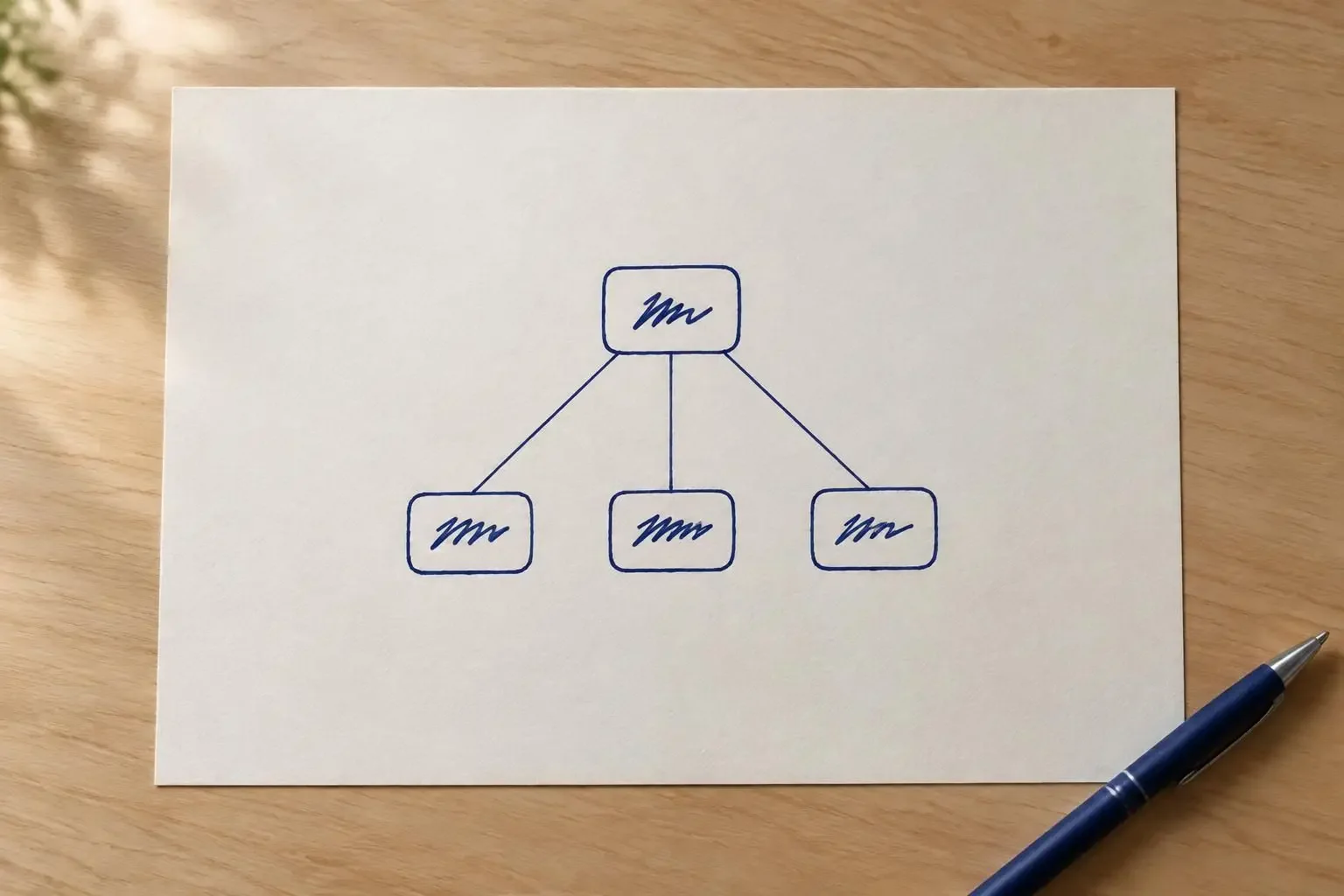
The pyramid principle is Barbara Minto's method for grouping ideas under a single governing point. The main idea comes first, the supporting ideas come next, and the detail sits beneath each one. Minto wrote it for readers; the same shape works for a spoken update.
Barbara Minto is an American author and consultant whose work, according to Wikipedia, focuses on executive communication. Her site states the rule directly: "The Minto Pyramid Principle says that your thinking will be easy for a reader to grasp if you present the ideas organized as a pyramid under a single point." The method is set out in her book The Pyramid Principle: Logic in Writing and Thinking (Pearson, 2021 edition).
A pyramid has three levels:
Governing point. The one idea everything else supports.
Key supporting ideas. Two to four ideas, each a reason, a step or an option.
Detail under each idea. The facts, figures or examples that prove one supporting idea.
One grouping tip, offered as coaching advice rather than Minto's rule: keep each group to one kind, such as all reasons, all steps or all options.
Sample wording, a spoken pyramid:
"I recommend we delay the launch two weeks, for three reasons. First, payment testing is incomplete: two of five scenarios still fail. Second, support training ends on the 14th. Third, the partner contract signs on the 18th. A launch on the 28th clears all three."
How many main points work in one spoken answer?
Plan three main points, and stop at four. Memory research puts the central capacity limit at about four chunks, not the popular seven. In persuasion experiments, impressions peaked at three positive claims, and a fourth claim made people skeptical of all the claims.
Two lines of research point to the same small number:
- Memory capacity. Cowan (2001, Behavioral and Brain Sciences) reviewed short-term memory research and wrote that Miller's famous seven was offered "more as a rough estimate and a rhetorical device than as a real capacity limit." The data point to "a single, central capacity limit averaging about four chunks." A chunk is one meaningful unit, such as one supporting idea. A plan of three points, plus the ask, can stay inside that limit when each point is one chunk.
- Number of claims. Shu and Carlson (2014, Journal of Marketing) tested how many positive claims persuade best. When people knew the source wanted to persuade them, impressions improved up to three claims. At the fourth, "persuasion knowledge causes them to view all the claims with skepticism." The study tested persuasive claims, so the three-claim rule fits recommendations and proposals, not every kind of speech.
A plan that needs a fifth point needs a second conversation or a written follow-up.
What does a scattered answer sound like next to a structured one?
A scattered answer follows the order the speaker remembers events; a structured answer leads with the point the listener needs. The scattered version saves the conclusion for the end. The structured version states it first, adds two supports, and closes with the next step.
Three work moments, in sample wording:
Status update. "Where are we on the vendor migration?"
- Scattered: "So we started the export last month, then the vendor changed their API, so we redid the mapping, and legal wanted another review, so I think we're about a week behind."
- Structured: "We're one week behind; the new go-live date is the 21st. The vendor's API change forced a remap, and legal added a second review. Both are done, and I'll confirm the date with the vendor on Friday."
Recommendation. "Which tool do we pick?"
- Scattered: "Tool A is cheaper, but its reporting is weak. Tool C has great reviews, though onboarding takes months. Tool B costs a bit more and connects to our CRM, so, overall, Tool B, I guess."
- Structured: "I recommend Tool B. It connects to our CRM, and the team can start using it in two weeks. I need budget approval by the 30th to lock the price."
Problem report. Raising a late deliverable with a manager.
- Scattered: "The design files came in late, then the printer had a backlog, and a second printer needed new proofs, so the brochures will be late, sorry."
- Structured: "The brochures will be three days late, and I need your approval for rush printing. The design files arrived late, and our usual printer has a backlog. With approval today, the brochures arrive before the trade show."
An r/PublicSpeaking poster described the scattered pattern from the inside: repeating, rephrasing and running "through an entire trail of thought."
Each structured version gives the listener a frame before the details arrive. Ausubel (1960, Journal of Educational Psychology) tested whether introducing key concepts first, which he called advance organizers, helps people learn and retain unfamiliar material. That study used written material with students, not meetings. Applied to speech, the idea is to say the point first so listeners can place each detail.
How do you organize your thoughts quickly before a meeting?
Spend thirty seconds on each agenda item you expect to speak to. Write three items as keywords: the point, one supporting fact, and what you need from the room. Keywords, unlike a script, let you speak naturally and still find your place after an interruption.
This 30-second planning routine is a coaching convention, not a research finding, and it fits the minutes before most meetings. The keyword card has three lines:
Point. The one sentence you want the room to remember.
Proof. One fact, figure or example behind the point.
Ask. The decision, input or help you want from the room.
Sample card for a Q3 budget item: "Point: 4% under budget. Proof: travel freeze since July. Ask: move the savings to hiring."
Recurring meetings use the same three-line template every week. An r/careerguidance reply describes giving a Monday update to around 30 people from "a bullet pointed list in a paper notebook," until the notes were no longer needed.
The method itself is short. The next sections cover why the plan breaks under load, when to change the order, and how to practice.
Why are your thoughts clear in your head but jumbled when you speak?
Thoughts often feel clear in your head because thinking does not force an order, and speaking does. Speech production separates deciding what to say from finding the words. An unfinished message plan can send related thoughts out in arrival order, which sounds like rambling.
An r/socialskills thread title names the experience: "speak perfectly in your head but as soon as you speak, it's all jumbled." Speech science explains the gap in two parts:
- Planning comes before wording. Levelt's model of speech production, set out in Speaking: From Intention to Articulation (1989), places the message plan, what to say and in what order, ahead of the choice of words and sounds. A speaker who starts talking before the message plan is finished may be doing both jobs at once.
- Filtering keeps talk on target. Arbuckle and Gold (1993, Journal of Gerontology) studied 205 adults aged 61 to 90. In that sample, "off-target verbosity, defined as extended speech that is lacking in focus or coherence," was predicted by tasks measuring the ability to suppress irrelevant information in working memory. The sample was older adults, so the finding describes a mechanism, not an age effect: off-target talk tracked the ability to suppress irrelevant information in working memory.
The practical filter is one question asked before each new thought: does this thought support the point? A reply in another r/socialskills thread gives the same advice, to "ask yourself if the current 'intrusive' thought is relevant to your main point."
For some professionals, the jumble shows up mainly under pressure. That pattern is the focus of anxiety coaching for professionals who ramble under pressure. A separate guide explains why some people write clearly but lose the thread when speaking.
When do you lead with the bottom line?
Lead with the bottom line for status updates, requests and recommendations, but not for every message. Bad news and listeners without background need one sentence of context first, then the point. That context sentence orients the listener without delaying the answer past the second sentence.
Bottom line up front, or BLUF, is defined on Wikipedia as "the practice of beginning a message with its key information." BLUF is an answer-first order, and the pyramid principle also puts the governing point first. Three cases call for one sentence of context before the bottom line:
Bad news. A listener hearing about a loss, a delay or a cut needs a moment to orient.
An unfamiliar audience. People new to the project lack the background to place the point.
Peers who need the reasoning. Colleagues asked to agree, not to approve, often want the why before the what.
Sample wording, bad news with one context sentence: "The client reviewed the pilot results yesterday. They are not renewing the contract, and our next step is a debrief with their team on Thursday."
A 2019 Hacker News thread on BLUF shows the same split. One commenter wrote that the "inverted pyramid talking style is so artificial." Another wrote that BLUF "works when the power relationship between the speaker and listener/reader/writer was established prior to the communication." Both are opinions, not research.
Updates to senior leaders put this choice to work, and those updates carry extra weight during a promotion cycle. Professionals preparing for that step can build the skill through promotion coaching on thought organization and message clarity.
How do you organize your thoughts while you are speaking?
Organize your thoughts while speaking by holding one point and returning to it. Say the point early, announce how many parts follow, and test each new thought against the point. A thought that does not support the point waits for a follow-up question.
Three moves hold the plan together in the moment:
Signpost the structure: "Two things. First…"
Restate the point before you finish, so the last sentence matches the first.
Recover with "Back to the main point:" when you notice a drift.
An r/ADHD reply about rambling in meetings offers a short self-cue: "I tell myself to 'land the plane'." For people with ADHD, an external structure helps, such as the point written on a card, and a separate guide sets out communication structures that help ADHD brains.
Questions you did not see coming are a separate skill, covered in a guide to answering a question you did not prepare for.
What exercises help you organize your thoughts?
Five exercises build the habit: a daily one-sentence point, a recorded voice-note rewrite, a self-interview with written headings, a scattered-to-structured rewrite of a sent message, and a fixed template for a recurring update. Each exercise uses real work material, so practice carries into meetings.
1. Write one sentence a day that states your view on a live work question. Trains: finding the point.
2. Record a 60-second voice note on a current project. Check whether the first sentence is the point, then record it again. Trains: point-first order.
3. Interview yourself. Ask a work question out loud, answer it, then write the answer as headings with bullets. A reply on r/careerguidance suggests this drill: "Interview yourself" and "Make section headers." Trains: grouping.
4. Rewrite one sent email or chat message as point, supports and ask. Trains: spotting a buried conclusion.
5. Template your recurring update with the Point, Proof, Ask card from the meeting routine. Trains: speed.
For a guided version, the Stop Rambling, Start Leading webinar package pairs a 1-hour webinar with a guided handout and a 7-day carryover practice guide for moving the habit into work conversations.
When do you see a speech-language pathologist about disorganized speech?
See a speech-language pathologist for an assessment when disorganized speech is new, follows an illness or injury, or affects daily life beyond work. Speech-language pathologists work with attention, memory and executive functioning. ASHA's scope of practice also lists business communication as an elective service.
The American Speech-Language-Hearing Association's Scope of Practice in Speech-Language Pathology (approved 4 February 2016) lists "Attention," "Memory," "Problem solving" and "Executive functioning" under cognition, and names "Business communication" among elective services. An assessment separates a planning habit that coaching can change from a difficulty that calls for clinical care. This guide offers no diagnosis.
Sydney Parriott, MA, CCC-SLP, MBA, is a licensed corporate speech-language pathologist. She teaches thought organization as part of Content, Pillar 4 of The Resonant Communication Method™: what you say and how you organize it. The skill also features in our live workshops on thought organization and audience awareness, 90-minute virtual sessions led by a licensed speech-language pathologist.
Organizing Your Thoughts FAQs
Does a full script help before speaking?
No, not for meetings or conversations. A script breaks the moment someone interrupts or asks a question, and reading aloud sounds different from talking. Write keywords instead: the point, the supports and the ask. Keep full scripts for a short opening line or a formal statement read word for word.
What is the difference between the pyramid principle and PREP?
PREP, short for Point, Reason, Example, Point, carries one point with one reason and one example. The pyramid principle groups several supporting ideas under one governing point, with detail beneath each idea. Use PREP for a quick opinion and the pyramid for a status update, a proposal or a recommendation.
Does organizing your thoughts make you sound rehearsed?
No. Organizing decides the point and the order, not the exact words, so the sentences still form in the moment. Rehearsed speech comes from memorizing wording. Plan the structure, practice saying it two different ways, and the delivery stays conversational even when the order is fixed.
Can you use the same structure for speaking and writing?
Yes, with two changes for speech. A reader can glance back up the page, and a listener cannot, so a speaker announces the structure, such as "Two risks. First," and restates the point at the end. Minto framed the pyramid principle around a reader, and spoken updates keep its order.
Sources
Cowan, N. (2001). The magical number 4 in short-term memory: a reconsideration of mental storage capacity. Behavioral and Brain Sciences, 24(1), 87–114. doi.org/10.1017/S0140525X01003922
Shu, S. B., and Carlson, K. A. (2014). When Three Charms but Four Alarms: Identifying the Optimal Number of Claims in Persuasion Settings. Journal of Marketing, 78(1), 127–139. doi.org/10.1509/jm.11.0504
Arbuckle, T. Y., and Gold, D. P. (1993). Aging, inhibition, and verbosity. Journal of Gerontology, 48(5), P225–P232. doi.org/10.1093/geronj/48.5.p225
Ausubel, D. P. (1960). The use of advance organizers in the learning and retention of meaningful verbal material. Journal of Educational Psychology, 51(5), 267–272. doi.org/10.1037/h0046669
Levelt, W. J. M. (1989). Speaking: From Intention to Articulation. MIT Press. doi.org/10.7551/mitpress/6393.001.0001
Camerer, C., Loewenstein, G., and Weber, M. (1989). The Curse of Knowledge in Economic Settings: An Experimental Analysis. Journal of Political Economy, 97(5), 1232–1254. doi.org/10.1086/261651
Minto, B. (2021 edition). The Pyramid Principle: Logic in Writing and Thinking. Pearson.
Barbara Minto. barbaraminto.com
American Speech-Language-Hearing Association (2016). Scope of Practice in Speech-Language Pathology. asha.org/policy/sp2016-00343/
Dispositio. Wikipedia. en.wikipedia.org/wiki/Dispositio
BLUF (communication). Wikipedia. en.wikipedia.org/wiki/BLUF_(communication)
Barbara Minto. Wikipedia. en.wikipedia.org/wiki/Barbara_Minto
Forum posts quoted in the text:
Reddit, r/PublicSpeaking. I ramble at work. How can one become a more concise speaker at work meetings where you can't prepare? reddit.com/r/PublicSpeaking/comments/18ppxlo/
Reddit, r/socialskills. Does anyone else speak perfectly in your head but as soon as you speak, it's all jumbled and non-sensical? reddit.com/r/socialskills/comments/k9q62h/
Reddit, r/socialskills. I have trouble organizing my thoughts when I talk. reddit.com/r/socialskills/comments/97o77l/
Reddit, r/careerguidance. reddit.com/r/careerguidance/comments/zgqnpn/
Reddit, r/careerguidance. How do i get better at organising my thoughts and articulating them? reddit.com/r/careerguidance/comments/ol5ae0/
Reddit, r/ADHD. Are there any ways you guys use to stop rambling and stick to a point, in meetings or general day to day small talk? reddit.com/r/ADHD/comments/r5js79/
Hacker News. BLUF: A military standard to make writing more powerful. news.ycombinator.com/item?id=20964907