
Storytelling for business is telling a short, true story to make a work point stick in a meeting, an update or a presentation. A business story names a person, the moment something changed, what was done and the result, then ties back to one point and one ask. A 2021 meta-analysis of 37 articles with 33,078 participants found that stories were remembered and understood better than plain explanation.
What is storytelling for business?
Storytelling for business is using a short, true story to make a work point clear and memorable. A business story has a person, a moment when something changed, what was done and the result. The story ends on one point the listener can act on.
The phrase "business storytelling" names the same skill. Management research studies the topic as organizational storytelling, and the Wikipedia article on that field calls it "also known as business storytelling."
Six work moments carry a story well:
A team update on a changed plan.
A project debrief after an incident.
An executive update that asks for a decision.
A presentation that needs a reason to care.
A performance review.
A change announcement.
This guide covers stories a person tells out loud at work. Brand storytelling, the narrative a company tells its customers, is a separate marketing practice.
In The Resonant Communication Method™, storytelling sits in Content, Pillar 4: what you say and how you organize it.
How do you tell a story at work, step by step?
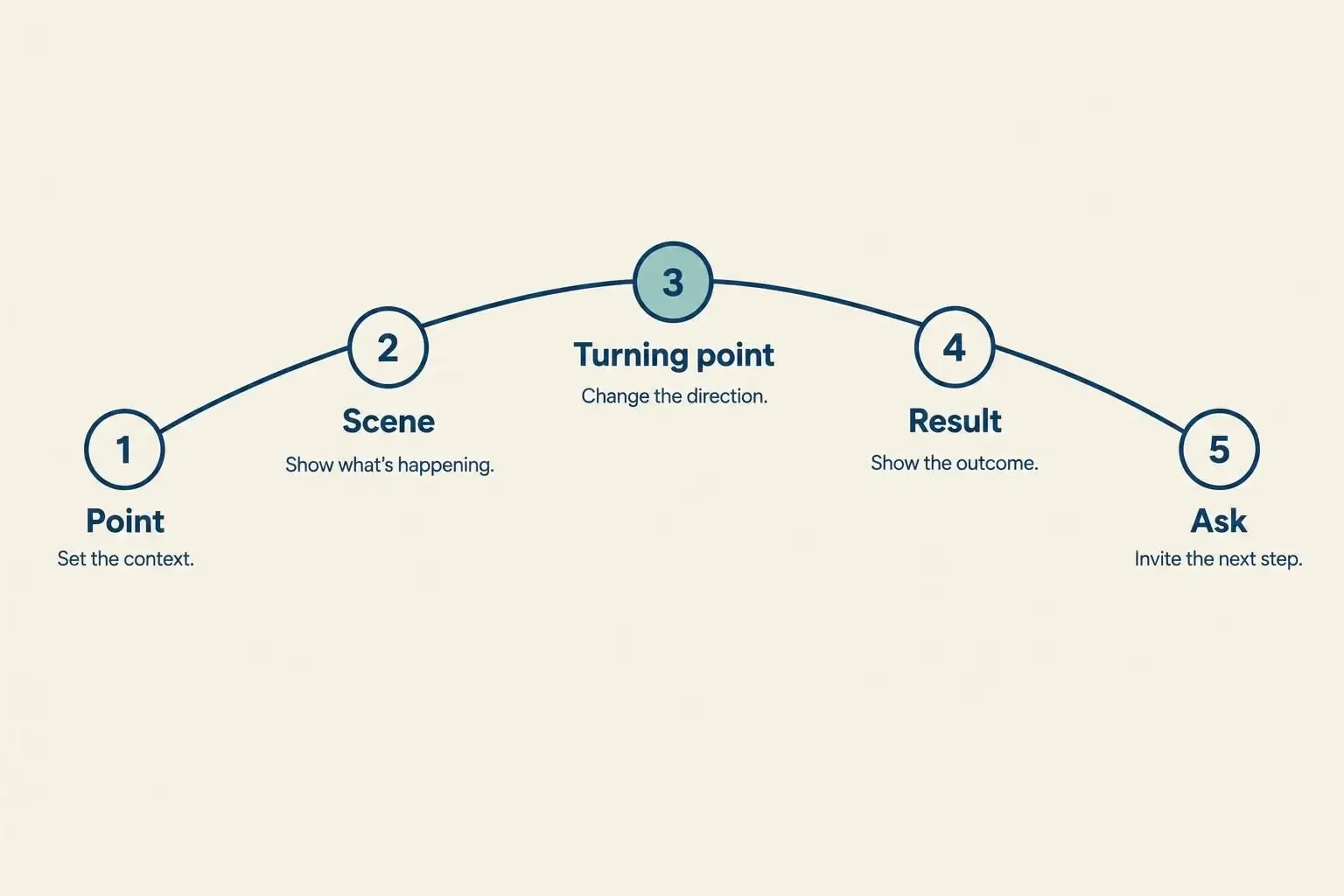
To tell a story at work, decide the point first, then pick one moment that proves it. Set the scene in one sentence, describe what went wrong or changed, say what was done, give the result, and close by restating the point and the ask.
Five steps build a business story:
1. Decide the point in one sentence before choosing the story. A reply on Reddit's r/ProductManagement put the rule plainly: "Start with the decision, not the background."
2. Choose one moment with one person in it. A customer or a colleague often makes a stronger main character than the speaker.
3. Build the arc: situation, turning point, action, result. The turning point is the reason the story exists.
4. Close by restating the point and naming the ask: a decision, an approval or a change in behavior. A story without an ask leaves the listener guessing.
5. Say the story aloud, time it and cut it. Spoken length decides which details stay.
Sample wording (invented for illustration, not a client story): a team lead asks for a release checklist. "Two Fridays ago, we pushed the pricing update at 4 p.m. By 6, billing had charged 300 customers twice. Our on-call engineer spent the weekend issuing refunds. A ten-item release checklist would have caught the missing test. I'm asking us to adopt one before the next release."
Each step maps to a framework, and the next section matches frameworks to work moments.
Which storytelling framework works best for business?
The best storytelling framework is the one that matches the moment. STAR (situation, task, action, result) suits interviews and project debriefs. Situation, complication, resolution suits executive updates. Before, after, bridge suits proposals and change. Each moves the listener from a starting point to a result.
Five frameworks cover most work moments. Each sample line is invented for illustration.
STAR (situation, task, action, result) for a project debrief. Sample: "The migration was due Friday. I owned the data checks and ran them during the move. We lost zero records." Interview answers follow the same order, covered in the guide to STAR answers in a job interview.
Situation, complication, resolution (SCR) for an executive update. Sample: "Signups are on plan. A competitor cut prices last week. We recommend a 30-day trial."
Before, after, bridge for a proposal or a change request. Sample: "Approvals take five days. One shared form makes it one. The form is ready to pilot." Client pitches use the same shape, as the guide to stories in a client pitch shows.
Context, action, result (CAR) for a quick example in a meeting. MindTools sets out CAR as its structure for a persuasive story.
A simplified hero's journey for a vision or culture talk. The customer or the team is the hero, and the speaker is the guide.
Reuse one framework per recurring meeting, so the audience learns the shape and follows faster. That advice comes from coaching practice, not a study.
Why is storytelling important in the workplace?
Storytelling matters at work because people understand and remember stories better than plain explanation. A 2021 meta-analysis of studies with 33,078 participants found narratives were recalled and understood better than expository texts. A 2016 meta-analysis linked stories to small shifts in beliefs and intentions.
Three findings support business storytelling, each with limits:
Memory and understanding. Mar, Li, Nguyen and Ta (2021, Psychonomic Bulletin & Review) pooled 37 articles, 78 samples and 33,078 participants. Narratives beat expository texts, with a larger advantage for memory than for comprehension. Results varied widely between studies.
Listening as well as reading. In the same meta-analysis, the narrative advantage was similar for listening and for reading. The benefit is not limited to the page.
Beliefs and intentions. Braddock and Dillard (2016, Communication Monographs) linked narratives to beliefs, attitudes, intentions and behaviors. The effects were small (correlations of .17 to .23), and the medium of presentation did not change them.
Green and Brock (2000, Journal of Personality and Social Psychology) named one mechanism: transportation, being absorbed in a story through imagery, feeling and attention. Across four experiments, higher transportation went with more story-consistent beliefs.
A story does not replace the facts. A story helps the listener hold them. The next sections cover when stories help less and how to tell them well.
Should you use a story or data at work?
Use a story and data together, story first. Open with one specific case so the numbers have meaning, then show the data that proves a pattern. Three experiments by Krause and Rucker found stories can either strengthen or weaken the persuasive power of facts.
Krause and Rucker (2020, Personality and Social Psychology Bulletin) titled the paper "Strategic Storytelling: When Narratives Help Versus Hurt the Persuasive Power of Facts." The abstract states that "coupling facts with stories can either enhance or undermine persuasion." A story is a choice, not a default. The story-first order is coaching practice: the experiments tested when stories help or hurt, not this order. Mar and colleagues add their own caution: the 2021 results "should not be interpreted as a suggestion to force all information into a narrative form."
Three moves place the data:
Leading with one case, so the numbers attach to a person.
Showing the number that proves the case is typical.
Naming the decision the data supports.
Sample wording (invented for illustration): "On Tuesday, one clerk re-keyed 200 invoices by hand. That was a normal day. Across the team, manual entry takes 11 hours a week. Automating intake frees those hours."
Story is one of three ways to add interest to a message, alongside analogy and data. The content digital workbook lets you practice adding interest with story, analogy and data.
How long should a business story be?
Most business stories work best at 60 to 90 seconds in conversation and two to three minutes inside a presentation. Those ranges come from practitioner guidance, not research. Keep the turning point and the result, and cut every detail that does not serve the point.
The ranges come from the FAQ in Rework's guide "Storytelling at Work: How to Communicate With Impact." The research reviewed for this guide sets no length.
Three cuts shorten a story fast:
Cut backstory older than the problem.
Cut names and dates the listener does not need.
Cut the second example. One moment proves the point, and two moments compete.
A story runs longer than a plain answer to a question, which our guide to impromptu answers keeps to 30 to 60 seconds. The extra time is worth spending only when the story carries the point.
Why do work stories ramble?
Work stories ramble when they follow the timeline instead of building toward one point. The listener hears context, then more context, and loses the reason for the story. Decide the point and the ending before speaking, and drop steps that do not change the outcome.
A poster on Reddit's r/ProductManagement described the pattern: "I tend to tell the story as a timeline of events." The feedback the poster received was to organize stories "around the key decisions I made, the trade-offs I considered."
Linguistics has a model for spoken stories. Labov and Waletzky (1967) studied how people tell stories of personal experience out loud. As summarized in the Wikipedia article on William Labov, the model names these parts:
- Orientation: who, where and when.
- Complicating action: what happened.
- Evaluation: why the events matter.
- Resolution: how the events ended.
- Coda: the return to the present.
The fuller model can also open with an abstract, a one-line summary of the story, which matches the business habit of stating the point first.
Read through Labov's model, a rambling work story is mostly orientation with no evaluation, and the evaluation is the part a business audience waits for. Three fixes restore it:
- State the decision early.
- Cut the orientation to one sentence.
- Say the evaluation out loud: "That's why the checklist matters."
Stories also fall apart on the spot. A reply in another r/ProductManagement thread gave the fix: "always know the narrative you want to get across BEFORE you need to speak." The guide to answering off the cuff covers that skill.
How do you tell a story out loud so it lands?
Tell a story aloud by slowing down at the turning point and pausing before the line that matters. In a 2010 study, words that followed a silent pause in speech were more likely to be recognized in a later memory test.
MacGregor, Corley and Donaldson (2010, Neuropsychologia) tested listeners with a surprise memory test after they heard speech. Words that followed a silent pause were recognized better. The study's pauses were disfluent silent pauses, as its title says. It measured listeners' memory for words, not how a planned pause lands, so a planned pause before the key line is coaching practice built on that finding.
Five delivery habits come from speech-language pathology coaching practice, not from a single study:
Pace. Slow down at the turning point, where the story changes.
Pause. Hold one beat before the line that matters.
Pitch. Let the pitch move at the change, not on every sentence.
Volume. Drop the volume slightly for the key line instead of raising it.
Eye contact. Look at the listener when the point lands.
Thayer Leadership's guide "8 Ways to Be an Effective Storyteller at Work" puts the difference simply: "Don't report your story or present it; tell your story."
A story that reads well in an email can fall flat in a meeting, because a speaker plans words, order and timing in real time. The hub guide on why clear writers lose the thread when speaking explains that gap.
How do you use storytelling in a presentation?
Use storytelling in a presentation by placing one short story where the audience needs a reason to care. Common placements are the opening and just before the key recommendation. Tie the story to the slide's point in one sentence, then move to the evidence.
Three placements carry a presentation story:
Opening story. One moment, told without "let me tell you a story."
Middle story. One case that makes a key number concrete.
Closing callback. A return to the opening story's person, now with the result.
In the TEDx talk "The secret structure of great talks," Nancy Duarte describes a contrast between what is and what could be. A presentation story can sit on either side of that contrast: the problem as it stands, or the result after the change.
Our public speaking coaching is where you get coaching to build a narrative arc for a talk, one that opens strongly and closes in a way the audience remembers.
How do you tell a story about your own work without bragging?
Tell a story about your own work by centering the decision you made, not the list of tasks you finished. Name the problem, the trade-off you weighed and the result, with one number. Credit the team for its part, and state your own part plainly.
A poster on Blind (India WorkLife, 12 March 2026) named the frustration: "Sometimes the person with the best narrative ends up looking more valuable than the person who actually did the most work." The coaching view turns that around: a clear story is how decision-makers see work they did not watch happen.
Four parts make a self-promotion story fair to the team:
Problem: what was broken or at risk.
Decision and trade-off: what you chose and gave up.
Result with one number: the outcome, measured once.
Team credit plus your part: who helped, and what you did.
Sample wording for a performance review (invented for illustration): "Renewals were slipping in Q2. I called our 20 largest accounts before redesigning the emails, which delayed the redesign a month. Renewals recovered to 94%. Sales ops built the call list; I ran the calls."
Performance reviews and promotion moments are where this story gets told, and our coaching for performance review conversations prepares it for the room.
How do leaders use storytelling at work?
Leaders use storytelling to explain why a change is happening and where the team is going. A short story about a customer, a mistake or a turning point gives the plan a human reason. Leaders also tell who-I-am stories that show their values.
Storytelling for leaders often draws on two story types from Annette Simmons' book Whoever Tells the Best Story Wins, as MindTools summarizes them: "Who-I-Am" and "Why-I-Am-Here." The names describe the job. One story shows who the leader is, and the other explains why the leader is asking.
Three leader moments call for a story:
New-team introduction. One story about a past decision that shows how the leader works.
Change announcement. One story about the customer or the problem that made the change necessary.
Lesson from a mistake. One story that names the error, the lesson and the fix.
A leader's mistake story works best when it names the lesson and the fix and stays away from blame. That is coaching advice, drawn from practice.
How can you improve your storytelling skills at work?
Improve storytelling at work by keeping a story bank, practicing aloud and testing each story on a listener. Note work moments with a clear before and after. Record one story, cut it to under two minutes, then ask a colleague to repeat your point back.
Five habits build the skill:
1. Collect a story bank of 5 to 10 work moments: wins, misses, customer moments and decisions. A story bank is a short written list of stories ready for meetings and updates.
2. Tag each story with the point it proves, so the right story surfaces in the right meeting.
3. Record one story and check whether the point arrives in the first two sentences.
4. Test the story on a colleague. A reply on Reddit's r/ProductManagement gave the test: "Watch where people interrupt. Confusion shows up as questions in the middle of your story."
5. Join a practice group. Toastmaster magazine (May 2020) describes the Pathways project "Connect with Storytelling" as "an elective project available in all 11 paths in Pathways."
Sydney Parriott, MA, CCC-SLP, MBA, is a licensed corporate speech-language pathologist. Sydney coaches message structure and storytelling in 1:1 work, using The Resonant Communication Method™. Teams that want a shared way to organize and present ideas can build it in our private workshops for teams.
Storytelling for Business FAQs
Can introverts be good storytellers at work?
Yes. Business storytelling depends on choosing one point, one moment and one ask, which are planning skills, not personality traits. A prepared story bank reduces the pressure to perform on the spot. A short, specific story told in a calm voice can land as well as a dramatic one.
Should a business story be true?
Use true stories about real work, with names removed. A hypothetical story suits explaining a process, as long as it is labeled: "Picture a customer who…" In Green and Brock's experiments (2000), labeling a story fact or fiction generally made no difference, but a work story should stay accurate.
What is the difference between business storytelling and brand storytelling?
Business storytelling, as used here, is a person telling a short story in a work conversation, update or presentation. Brand storytelling is a company's marketing narrative for customers. Organizational storytelling is the academic study of narrative inside organizations. All three use the same basic story parts.
How do you start a story without saying "Let me tell you a story"?
Open with the moment itself, not an announcement. Instead of "Let me tell you a story," start with a time and a place: "Last March, our largest client called to cancel." The time cue tells listeners a story has started, and the first sentence already sets the scene.
Sources
Mar, R. A., Li, J., Nguyen, A. T. P., and Ta, C. P. (2021). Memory and comprehension of narrative versus expository texts: A meta-analysis. Psychonomic Bulletin & Review, 28(3), 732–749. doi.org/10.3758/s13423-020-01853-1
Braddock, K., and Dillard, J. P. (2016). Meta-analytic evidence for the persuasive effect of narratives on beliefs, attitudes, intentions, and behaviors. Communication Monographs, 83(4), 446–467. doi.org/10.1080/03637751.2015.1128555
Krause, R. J., and Rucker, D. D. (2020). Strategic Storytelling: When Narratives Help Versus Hurt the Persuasive Power of Facts. Personality and Social Psychology Bulletin, 46(2), 216–227. doi.org/10.1177/0146167219853845
Green, M. C., and Brock, T. C. (2000). The role of transportation in the persuasiveness of public narratives. Journal of Personality and Social Psychology, 79(5), 701–721. doi.org/10.1037/0022-3514.79.5.701
MacGregor, L. J., Corley, M., and Donaldson, D. I. (2010). Listening to the sound of silence: disfluent silent pauses in speech have consequences for listeners. Neuropsychologia, 48(14), 3982–3992. doi.org/10.1016/j.neuropsychologia.2010.09.024
- Labov, W., and Waletzky, J. (1997). Narrative Analysis: Oral Versions of Personal Experience. Journal of Narrative and Life History, 7(1–4), 3–38. Reprint of the 1967 paper. doi.org/10.1075/jnlh.7.02nar
Scinto, J. (May 2020). Take Your Stories Along in Pathways. Toastmaster magazine. toastmasters.org/magazine/magazine-issues/2020/may/sidebars/take-your-stories-along-in-pathways
Rework (June 2026). Storytelling at Work: How to Communicate With Impact. resources.rework.com/libraries/employee-competencies/storytelling-at-work
MindTools. Business Storytelling. mindtools.com/a69x1bw/business-storytelling
Capozza, A. (January 2026). 8 Ways to Be an Effective Storyteller at Work. Thayer Leadership. thayerleadership.com/leadership-blog/eight-ways-to-be-an-effective-storyteller-at-work/
Duarte, N. (2010). The secret structure of great talks. TEDxEast. ted.com/talks/nancy_duarte_the_secret_structure_of_great_talks
Duarte. 7 Storytelling Tips for Better Business Presentations. duarte.com/blog/tips-for-crafting-a-storytelling-presentation/
Organizational storytelling. Wikipedia. en.wikipedia.org/wiki/Organizational_storytelling
William Labov. Wikipedia. en.wikipedia.org/wiki/William_Labov
Forum posts quoted in the text:
Reddit, r/ProductManagement. How to improve executive presence and speaking more like a product leader? reddit.com/r/ProductManagement/comments/1tuyycb/
Reddit, r/ProductManagement. Story telling skills for PMs. reddit.com/r/ProductManagement/comments/1qz36vc/
Reddit, r/ProductManagement. I want to improve real-time articulation skills. reddit.com/r/ProductManagement/comments/1tnha4v/
Blind. Performance reviews feel like storytelling contests. teamblind.com/post/performance-reviews-feel-like-storytelling-contests-lszoy8hu